


Bitcoin Freezes Over $100,000 As OG Whales ‘Dump | Crypto News
While Bitcoin continues to hover above the $100,000 threshold, the driving forces behind this historic consolidation section seem to be more complicated than the surface-level narratives of institutional “FOMO” and ETF euphoria. According to a number of main analysts, a silent rotation is underway—one that suggests long-term holders are offloading their positions while company treasuries and institutional consumers quietly take up the flood.
OG Bitcoin Whales Are ‘Dumping’ On Wall Street
Charles Edwards, founder of Capriole Investments, delivered a sobering breakdown via X on June 29, difficult the prevailing perception that Bitcoin’s price stagnation amid surging demand is anomalous. “People are wondering why BTC has been stuck at $100K so long, despite the institutional FOMO,” he wrote. “Despite what X news might suggest, it’s because Bitcoin OGs (long-term holders) have been dumping on Wall St since the ETF Launch in January 2024, unloading their positions.”
Edwards, identified for mixing on-chain metrics with macro frameworks, pointed to a seen dynamic shift that is now being captured in blockchain information. While older cash are being redistributed, a newer class of holders—primarily treasury-oriented entities—are stepping in aggressively. “We have clearly entered the heat of [the Treasury Company] trend today as many copy-cats have entered the market,” he mentioned, referencing his earlier prediction on Bits and Bips that company adoption would ultimately eclipse ETF inflows in relevance.
What makes this transition significantly outstanding is the information behind it. Edwards highlighted that 6-month-plus BTC holders—generally related with more strategic, non-speculative accumulation—have skyrocketed in the previous two months. “The amount of BTC acquired in the last 2 months by this cohort has completely consumed all of the BTC unloaded by LTHs over the last 1.5 years,” he mentioned. “Incredible.”
This cohort’s aggressive accumulation, he added, has traditionally preceded bullish squeezes. “Whenever aggressive spikes in 6M+ holders occur, price usually squeezes following these periods. Short-term bullish,” Edwards remarked. However, he tempered the optimism by cautioning that broader on-chain information still alerts fragility. “If the 6M+ holders (Treasury Companies) can continue their relentless buying, that should be achievable,” he famous, signaling that the flywheel has momentum, but is just not yet immune to systemic strain.
Adding one other layer to this developing narrative, Mauricio Di Bartolomeo, Co-founder and CSO at Ledn, provided an various idea. He prompt that what seems as two flows—LTHs promoting and Treasury entities shopping for—would possibly in truth be “the same trade.” He wrote, “Long term holders [are] selling spot to buy ETFs/BTC Treasury Cos. Even though that feels unnatural for us bitcoiners.” Di Bartolomeo framed the shift as generational, mentioning that many early adopters might merely be more snug in conventional financial custody somewhat than self-sovereign wallets.
But Edwards pushed back on that clarification, arguing that if ETF migration was driving the reclassification of long-term holders, it might be evident across a number of ageing cohorts. “I don’t think so because we would have seen a similar uptrend over time in the 6M+ and 1Yr+ cohorts if that was the case,” he replied. “Some is definitely moving to equities, but it’s very typical of this stage of the Halving cycle to see LTH selling into profit.”
Why Bitcoin ETF Do Not Have A 1:1 Effect On Price
The obvious dissonance between rising demand and stagnant price has also prompted commentary from on-chain analyst TXMC, who warned that most observers misunderstand what really units Bitcoin’s price. “Bitcoin people grossly underestimate how little of the supply is actually setting the price every hour,” he wrote. He described Bitcoin’s fragmented market construction as a web of siloed exchanges, loosely synchronized through cross-exchange market-making. “Each location has its own liquidity and depth which vary wildly. A large market order can have an outsized effect depending on which exchange it is placed at, and which time of day.”
TXMC argued that while ETFs and institutional desks are accumulating giant portions of Bitcoin, a lot of this exercise is routed through OTC desks that bypass order books fully. “These actions do not affect the price in the same way,” he mentioned. “The desks source their own liquidity, and only have to go into the books to fill the difference.”
This clarification might help reconcile why ETF inflows in the billions of {dollars} have failed to push BTC considerably increased. Edwards’ thesis aligns with this too, insofar as the ETF growth could also be fueling redistribution somewhat than outright web demand. TXMC added: “Stop underestimating how many big entities are out there looking for exit liquidity.”
Despite growing bullishness in cohort composition, the true check lies forward. Whether company treasuries and ETF managers can take up the remaining exit waves of Bitcoin’s earliest holders stays to be seen. But if Edwards is true, the rotation might already be previous its vital section.
“The flywheel still has a long way to go,” Edwards concluded. And if historical past is any information, these moments of consolidation amid redistribution have a tendency to precede volatility—not comply with it.
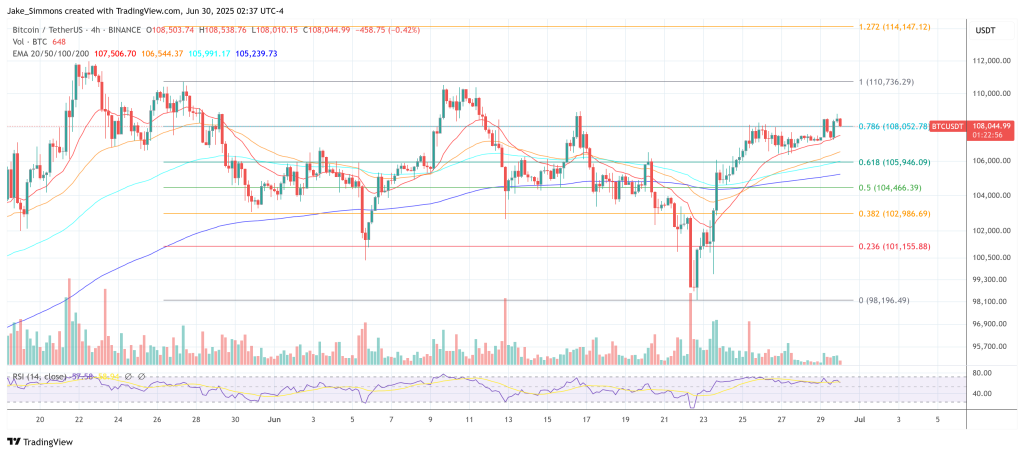
At press time, BTC traded at $108,044.
Stay up to date with the most recent trending crypto information! Visit our web site every day for the freshest Crypto information and content material, fastidiously curated to keep you knowledgeable.